Yuichiro Miura | Prospex Friends | Seiko Prospex
Professionel skiløber/eventyrjæger
Yuichiro Miura
Verdens ældste bjergbestigere der nåede toppen af Mt. Everest
PROFIL
I 1985 afsluttede han sit skiløb ned ad de højeste bjerge på verdens syv kontinenter.
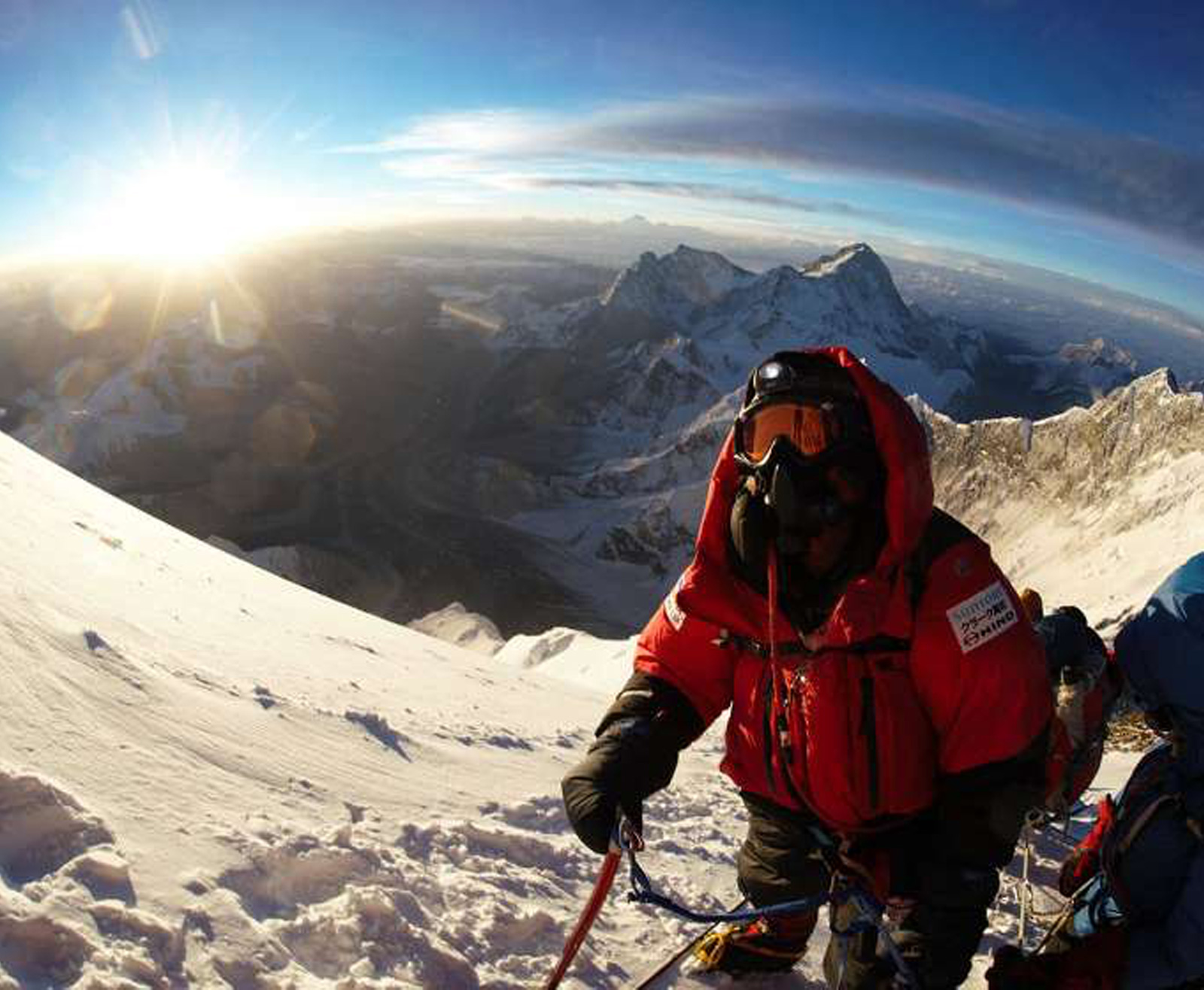
I 2003 nåede han og hans anden søn, Gota, toppen af Mount Everest og satte således verdensrekord som den ældste person til at nå toppen på det tidspunkt, 70 år og syv måneder gammel.
I 2008, i en alder af 75 år, nåede han toppen af Everest for anden gang, og i 2013, i en alder af 80 år, nåede han toppen for tredje gang og brød verdensrekorden som den ældste person til at nå toppen.
Udover at være eventyrskiløber er han også rektor på Clark Memorial International High School med over 10.000 studerende på landsplan. Han har også talrige dokumentarfilm, fotoboger og publikationer under sit navn.
INTERVIEW
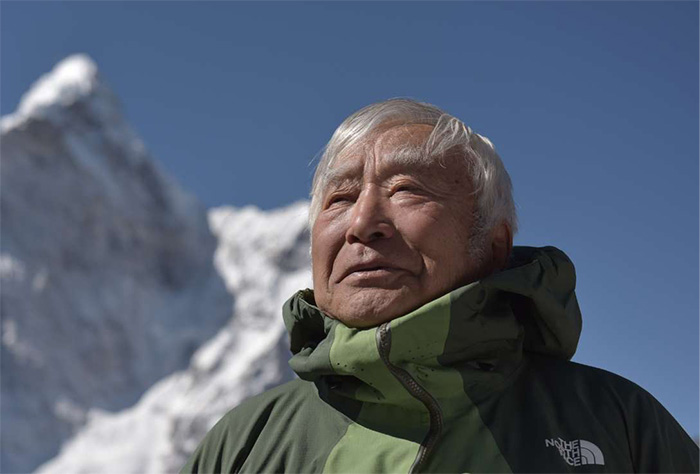
I en alder af 80 år lykkedes det eventyreren Yuichiro Miura at nå toppen af Mount Everest for tredje gang, hvilket gør ham til verdens ældste person til at gøre det. Hans vej dertil var præget af en serie af hidtil usete vanskeligheder.
Efter med succes at have bestiget Mount Everest for anden gang i en alder af 75 år besluttede han at gøre et tredje forsøg i en alder af 80 år. Året efter fejlede han dog en skisprings landing og brækkede fem knogler, herunder lårbenshovedet og bækkenet. Læger fortalte ham, at han ville være tvunget til at være i kørestol. Alligevel var hr. Miuras beslutning urokket. "Jeg vil helt sikkert blive rask. Jeg kommer til at hele mig og bestige" – med denne beslutning arbejdede han hårdt på et dagligt rehabiliteringsprogram og blev efter tre år fuldstændig rask. Han havde helt overvundet en situation, der blev betragtet som irreversibel.
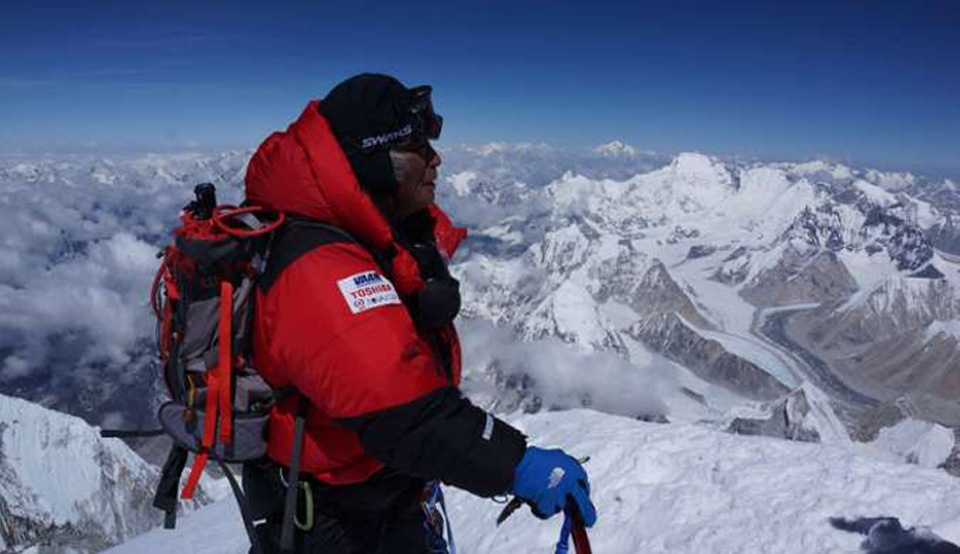
Således begyndte hans tredje angreb på Mount Everest, og han mødte endnu en serie af kampe, der var livsfarlige. På 5.000m basecamp var iltniveauet i luften allerede kun 50% af det ved havoverfladen. Selv mens han sov, steg hans puls, som om han løb jogging. Han kunne ikke sove, hans appetit faldt og hans styrke mindskes. Alligevel måtte han stadig bestige himalaya-klipperne. Det var en alt for vanskelig udfordring for en 80-årig.
Der var fare for et snarligt lavinesul. Vinden fejede, og det var svært at undgå flyvende sten. Temperaturen kunne nå -40 grader Celsius. Han mødte konstant livsfarlige farer og vidste aldrig, hvad han ville finde omkring næste hjørne. Alligevel fortsatte hr. Miura med at gå fremad og overvågede konstant sin fysiske tilstand. Når vinden ville ophøre kort og en klar himmel kunne ses, følte han ro.
"Jeg sagde til mig selv, at jeg ikke ville give op," mindes han. "Selv når jeg ville give op eller vaklet undervejs, rykkede jeg det altid af mig og fortsatte med at klatre opad."
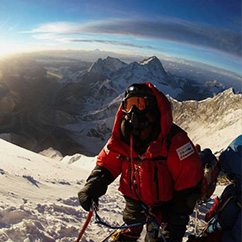
Endelig nåede han toppen af Mount Everest. Han følte en stigende følelse af præstation, som han aldrig havde følt før. Himmelpilorende 6.000- og 7.000-meter toppe i Himalaya, som han havde set op på fra basecamp, var nu synlige under ham. Tibets store sletter samt Indien var synlige i det fjerne, og Jordens fantastiske bjerge og landskaber spredte sig for hans øjne. Udsigten blev for altid præget i hans sind.
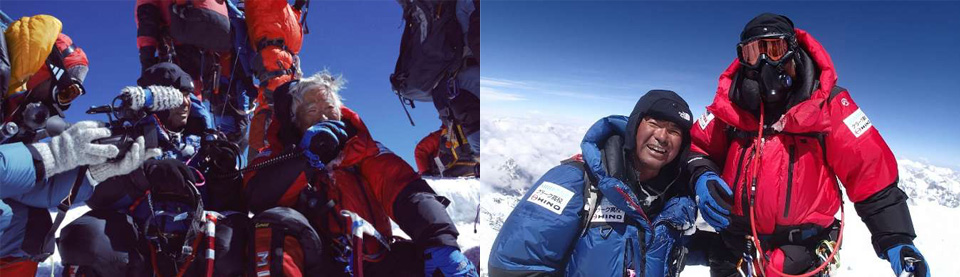
In the Tokyo office, a panel of photos taken at that time is on display. They show breathtaking scenes that only a handful of people who have made the climb have experienced.
“On the summit of Mount Everest, there is only one-third of the air that exists at sea level, and even with in supplement oxygen, you can’t stay for more than 30 minutes,” says Mr. Miura. “However, I found myself staying an hour to admire and photograph the view. To be able to spend an hour on Mount Everest, the highest point on earth, was the most extravagant experience I’ve ever had.”
In his office, he keeps the clothing and gear he used for his historic climb. His boots are so heavy and large that he can’t lift them with one hand. A snowsuit seems to be many times larger than his body. With such heavy gear, which only the most fit could carry, he hiked for several dozen days in the snowy mountains and climbed the cliffs. Every single piece of gear bears the memory of his harsh struggle with nature.
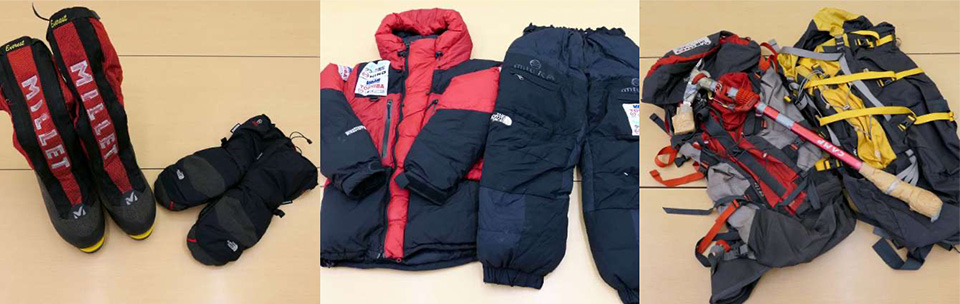
An air-filled mountaineering down coat is reminiscent of a space suit.
Mr. Miura says, “The summit of Mount Everest is the closest place on Earth to outer space. If you put on all this gear and seal it, you can go into space.”
It’s hard to imagine what it’s like to be in a place ultimately close to the outer space. Mr. Miura explains that to be in an environment so different from that of the sea level and to reach the summit of Mount Everest, all of his mountaineering clothing and all of his gear had to be the best in the world at the time. “What you see here is excellent gear for climbing. I selected it all strictly for its functionality,” he says. A climber’s life depends on the right gear.
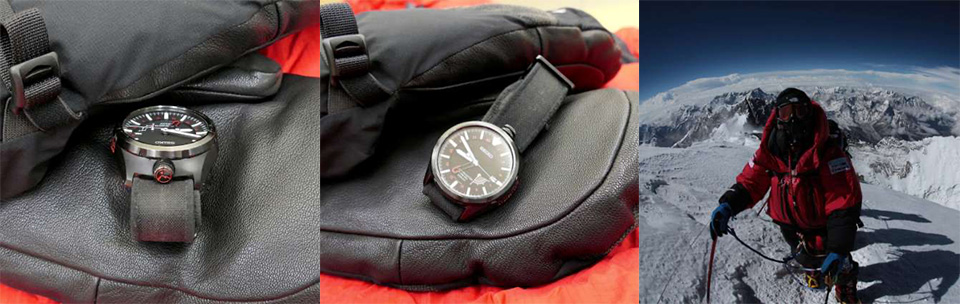
Among Mr. Miura’s gear was the Seiko Prospex, a special model developed at his request for its durability, legibility and accuracy. The words “Miura Everest 2013” are engraved on the side of the watch. For the adventurer who must follow a precise schedule, keeping accurate time can mean the difference between life and death.
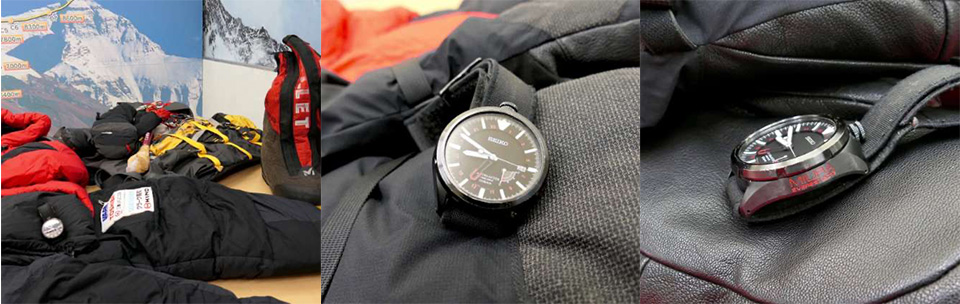
“The watch has the highest specs ever,” says Mr. Miura. “It didn’t fail even in the harshest of conditions, even when wet and frozen in a blizzard. It’s a wonderful watch that told me the time in the dark when I had to leave in the middle of the night and climb late at night.”
The movement is equipped with the Spring Drive, Seiko’s unique drive mechanism. Since it requires no batteries, it cannot be damaged or run out of battery during an ascent of Mount Everest, where temperatures fluctuate dramatically. In addition, it features increased shock resistance thanks to a unique regulating mechanism that uses the electrical signals of the IC and a quartz oscillator like those used in quartz watches.
To further enhance legibility, the hour and minute hands and indexes are thickly coated with Lumibrite, a phosphorescent paint that increases brightness. The case is made of lightweight and robust titanium. The crown is located at 12 o’clock.
Explains Mr. Miura, “I asked for this position so that it would be easy to operate while climbing, and wouldn’t interfere with wrist movements or get caught in the ropes. It’s truly the best watch I’ve ever had, custom-made and most reliable.”
One watch, Seiko Prospex, supported Mr. Miura so he could “Keep Going Forward.”
At the age of 88, Mr. Miura is still eager to take on challenges and move forward. He hopes to climb Mount Kilimanjaro in Africa at the age of 90. His father, Keizo Miura, skied down Mont Blanc at the age of 99, and is a constant presence in his mind. He firmly believes that “challenges strengthen your power to live,” as he wrote in his book, Yuichiro Miura: Only Humans Can Challenge the Limits, published by Heibonsha.
He writes, “Never give up on anything. To keep moving forward, you must never give up and stick with it to the end.”
 Seiko Prospex Lineup